How to Remove Unwanted Permanent Makeup: Laser vs Remover
Permanent makeup doesn’t always age well. Pigments shift colour over time - brows turn grey, orange or blue; lip colour fades unevenly; eyeliner bleeds or migrates. Shapes that once looked natural may no longer suit a changed face. And poorly executed work by an inexperienced practitioner can leave results that are far from what was originally wanted. If you’re living with permanent makeup you no longer like, removal is possible. But the method matters - and the wrong choice can make things worse, not better. There are two principal approaches: laser removal and chemical remover. Each works differently, suits different cases, and carries different risks. This guide explains both in detail so you can make an informed decision.
How Laser Removal Works
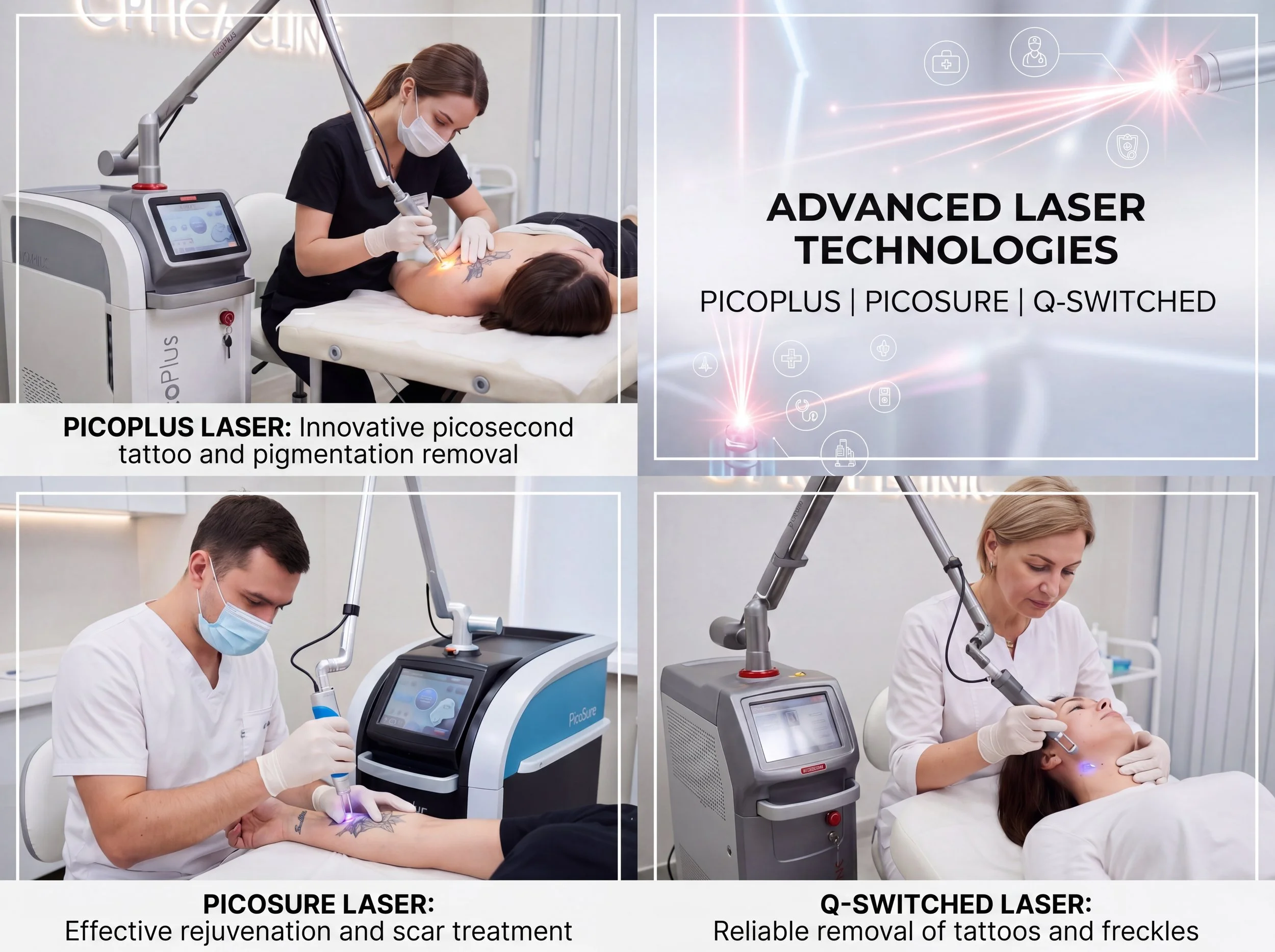
Laser removal uses focused light energy to break down pigment particles beneath the skin. The laser emits pulses at specific wavelengths, each targeting particular pigment colours. The shattered pigment fragments are then gradually absorbed and eliminated by the body’s immune system over a series of weeks. Modern Q-switched and picosecond lasers are the most commonly used devices for tattoo and permanent makeup removal. They deliver energy in extremely short bursts - nanoseconds or picosecond, which minimises heat damage to surrounding tissue while maximising pigment fragmentation.
Different Wavelengths for Different Colours
Not all pigment colours respond to the same laser wavelength. This is one of the most misunderstood aspects of laser removal. Each wavelength is absorbed by specific colour ranges:
1064 nm (Nd:YAG) - effective for dark pigments: black, dark brown and dark blue. This is the most commonly used wavelength and works well on body tattoo ink, but permanent makeup pigments behave differently.
532 nm (KTP) - targets red, orange and warm-toned pigments. However, this is also where the most serious complications occur with permanent makeup.
694 nm (Ruby) and 755 nm (Alexandrite) - effective for green and blue pigments. The key point is that laser removal is colour-dependent.
A single wavelength cannot remove all colours, and some colours cannot be safely removed by any wavelength at all. It often happens that after laser treatment you can see colour iversion. Why does this happen? It depends on the composition of the pigment.
Colour inversion - also known as paradoxical darkening - is not uncommon. It is a well-documented risk with pigments that predominantly contain red, white and yellow. For example, dark brows may suddenly turn red after laser treatment, or brown ones may turn yellow. A scar camouflaged with a beige pigment may turn grey or black after being heated by the laser.
This is the critical information that many clinics don’t explain upfront. Laser cannot safely or effectively remove white, beige, flesh-toned or yellow pigments. These colours - commonly used in permanent makeup for colour correction, camouflage or to lighten previous work - contain titanium dioxide or iron oxides that do not respond to laser in the expected way. Instead of fading, these pigments undergo a chemical reaction called oxidation. The laser energy causes the titanium dioxide to reduce, turning the pigment dark grey or black.
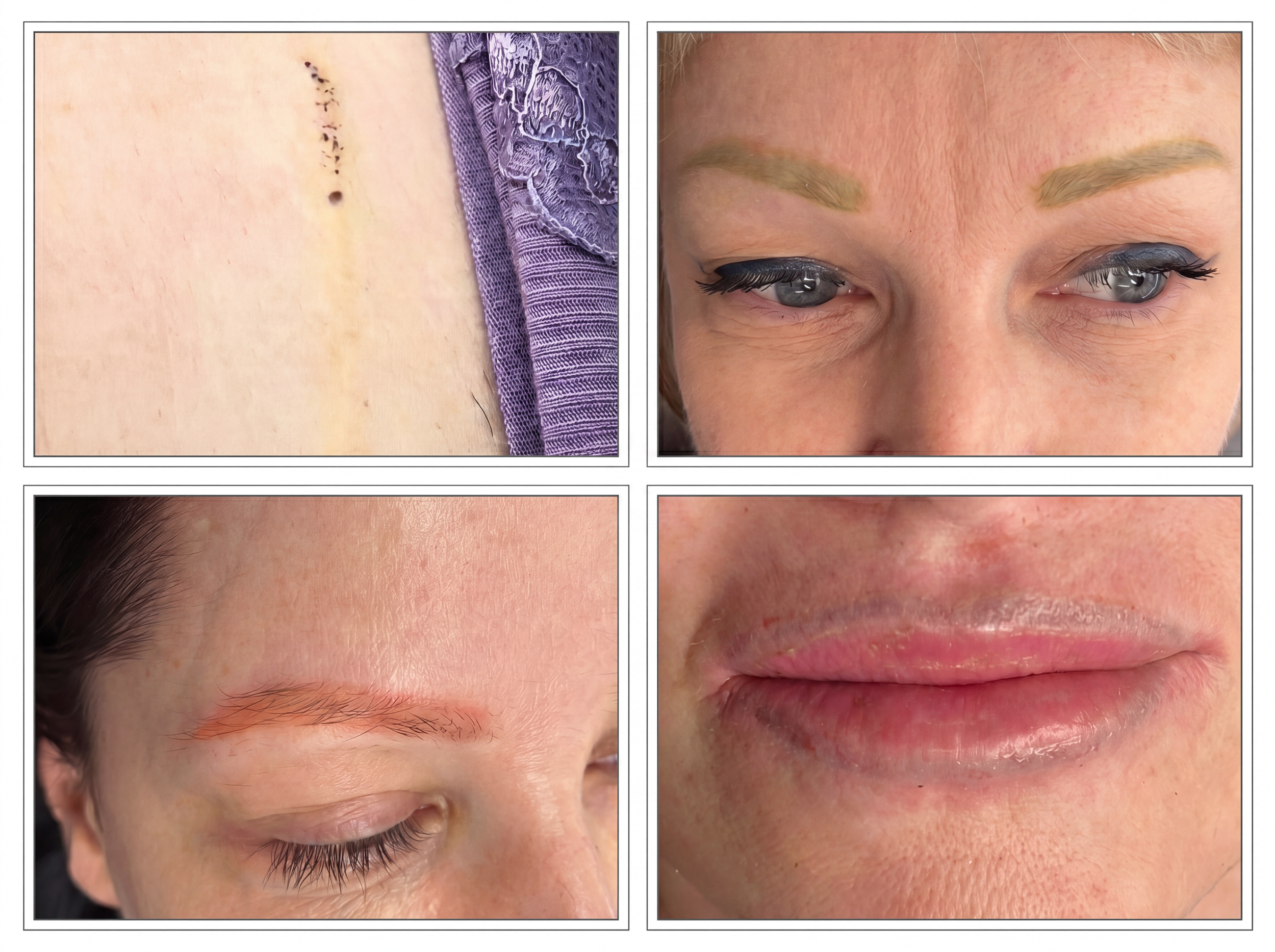
Inversion after laser removal
Other Risks of Laser on Permanent Makeup
Beyond colour inversion, laser removal of permanent makeup on the face carries several risks that differ from body tattoo removal.
Scarring - the skin on the face, particularly around the eyes and lips, is thinner and more delicate than body skin. Aggressive laser settings can cause textural scarring that is permanent.
Hypopigmentation - laser can destroy melanocytes (the cells that produce natural skin colour), leaving lighter patches of skin where the pigment was removed. On the face, this is highly visible.
Hyperpigmentation - paradoxically, laser can also trigger excess melanin production in some skin types, creating darker patches around the treated area. This is more common in darker skin tones.
Incomplete removal - even after multiple sessions, laser may leave shadow-like remnants of pigment that are visible in certain lighting. This is particularly common with permanent makeup pigments, which are formulated differently from body tattoo inks.
The proximity to the eyes is an additional concern with eyeliner removal. Specialist eye shields must be used, and not all laser clinics are equipped or trained for this.
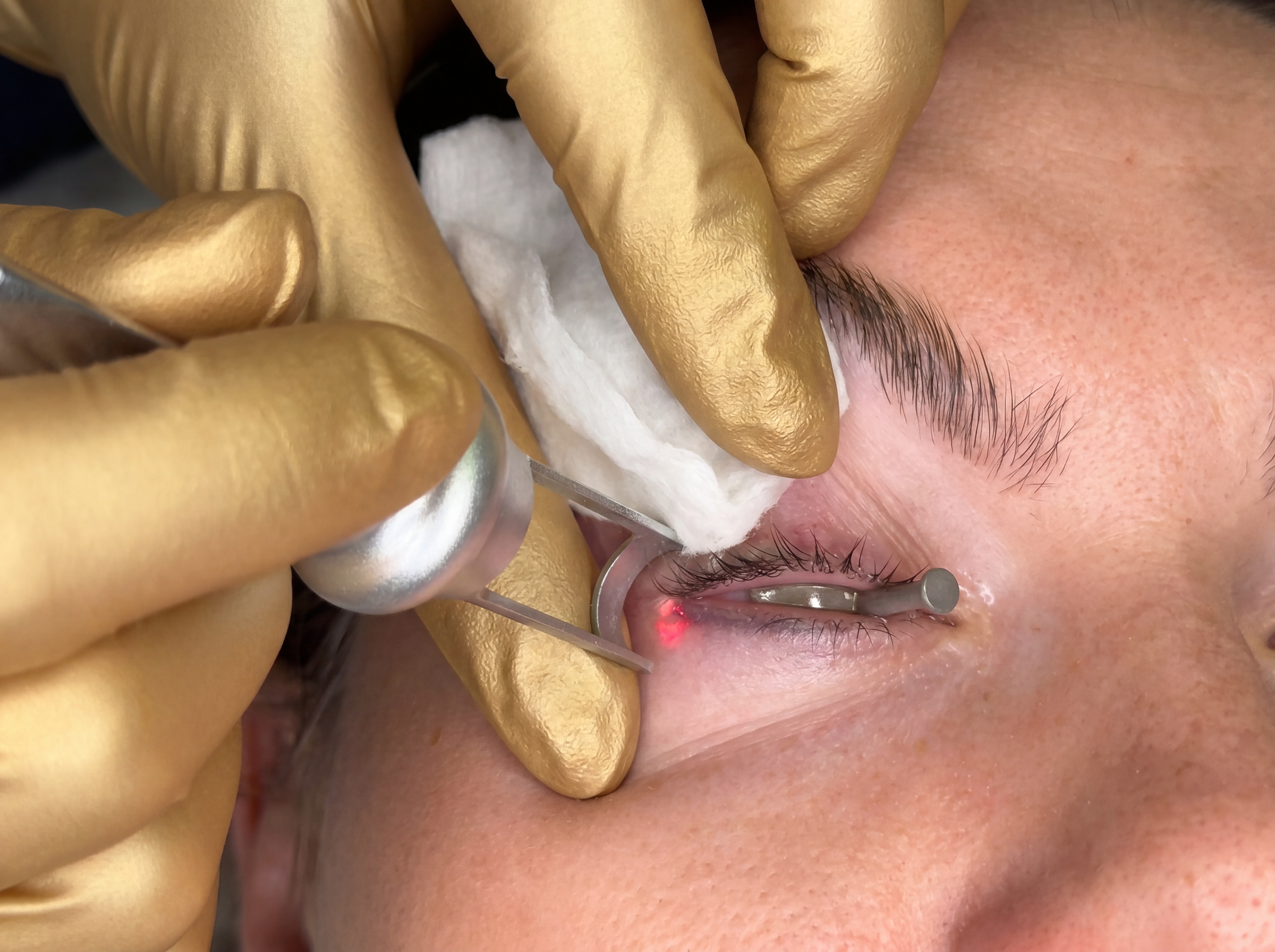
laser eyeliner removal using eye shield for protection
Chemical Removal - A Different Aproach
Chemical removal - also known as remover extraction - takes a fundamentally different approach. Instead of breaking pigment down with light, a specialised solution is introduced into the skin using a micropigmentation device (the same type of machine used to apply permanent makeup). The solution targets the pigment at the level where it sits in the dermis, binds to it, and draws it upward to the surface, where it is expelled through the natural healing process as a crust. This method does not rely on colour recognition. It works by acting on the pigment and the tissue surrounding it, regardless of what colour the pigment is. This is its single greatest advantage over laser: a remover can extract white, beige, yellow, flesh-toned and mixed pigments that laser cannot touch.
Types of Removers - and Why They Are Not All the Same
Not all removers are the same. They differ in their active ingredients, mechanism of action, and safety profile. Understanding the differences is essential, because the wrong choice can cause permanent damage.
Saline-based removers use a hypertonic salt solution that creates an osmotic effect, drawing pigment particles toward the surface. While this sounds gentle in theory, saline removers are weak in practice. Their action is superficial and often insufficient for removing established permanent makeup. Results are inconsistent, and many clients find themselves returning session after session with minimal improvement.
Acid-based removers (glycolic acid, lactic acid formulations) work like a chemical peel - they dissolve tissue on contact. The critical problem is that acid cannot be safely introduced beneath the skin using a micropigmentation device. Once deposited into the dermis, the acid reaction becomes uncontrollable — it continues to burn tissue indiscriminately, causing chemical burns, inflammation, and in many cases permanent scarring. Despite being marketed as professional removal systems, acid-based products carry the highest risk of complications and should be avoided for intradermal PMU removal.
Alkaline-based removers (such as Rejuvi) work on a fundamentally different and safer principle. The alkaline solution is introduced into the skin at the level where the pigment sits. Rather than burning tissue, it targets the fibrous tissue capsule that has formed around the pigment molecule — the body’s natural response to any foreign substance implanted in the dermis. The alkaline solution breaks down this fibrous capsule, releases the trapped pigment, and bonds with it. The pigment-remover compound is then transported to the surface by the lymphatic system, where it forms a crust. When the crust naturally lifts, the pigment comes with it.
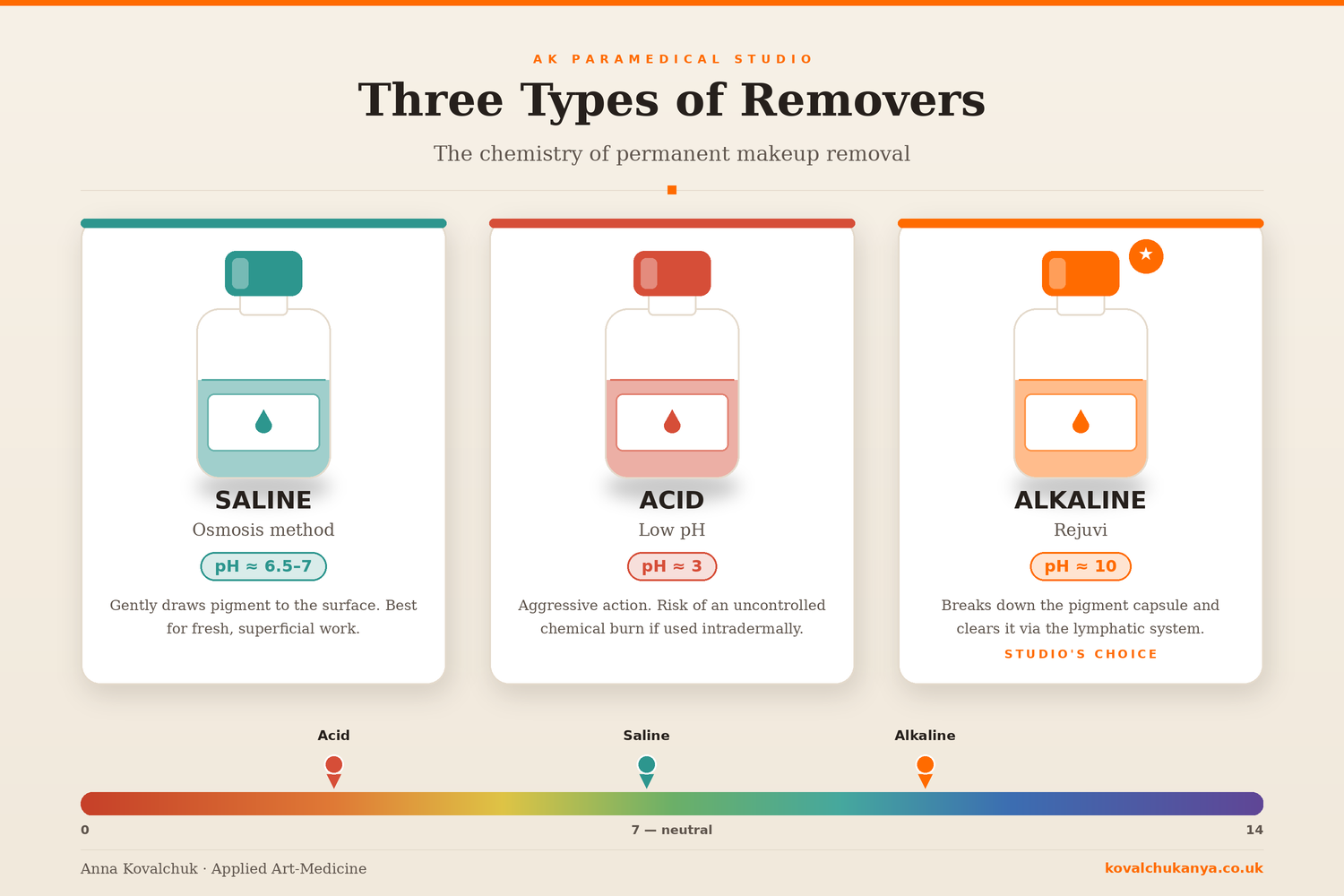
The three removers compared by pH and mechanism of action
This is a controlled, predictable reaction. The practitioner can regulate the depth, the amount of product, and the area treated. There is no uncontrolled chemical burn, no indiscriminate tissue destruction, and no colour inversion.
We use all types of removers, as every case is unique and therefore the approach to removal is individual.
Remover vs Laser
These are two non-interchangeable methods that more often complement each other. We can use laser inthe first session to reduce the density of the dark colour, and then use a remover to extract the pigment from the deeper leyar of the skin. By alternating methods and adapting to the situation, we achieve the most effective result.
Laser may be more appropriate for large-area body tattoos with dark ink, where the pigment is deep and the colour is predominantly black or dark blue. For standard body tattoo removal, laser remains the gold standard.
However, for permanent makeup on the face — where pigments are iron oxide-based, often mixed with white or flesh tones, and applied to delicate facial skin — professional alkaline removal is the safer, more predictable, and more effective option.
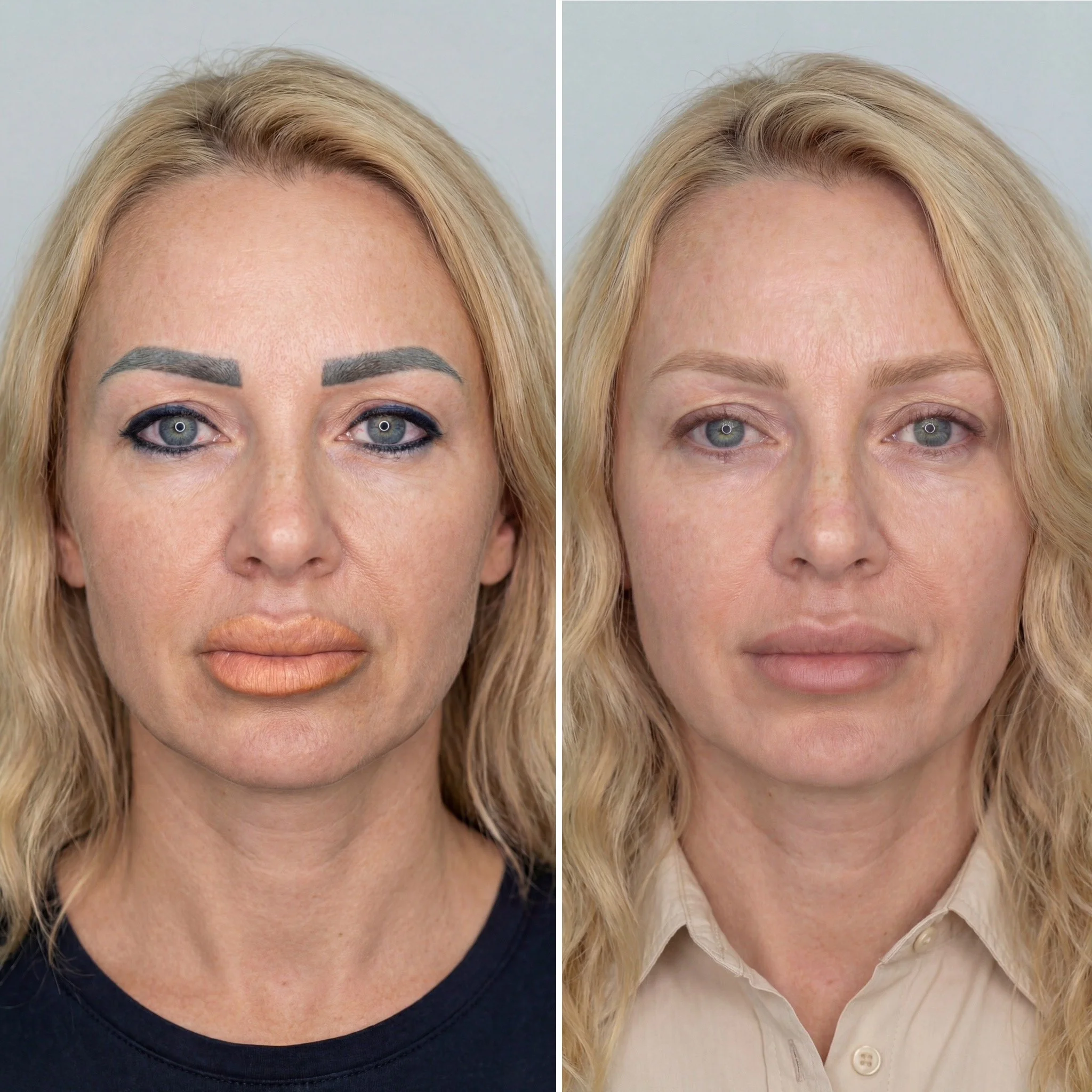
Before and after: complete removal of dark brows, eyeliner and inverted lip color
Many of our clients come to me after unsuccessful laser treatment — including cases of colour inversion where laser has turned flesh-toned or yellow pigment dark grey or black. In these cases, alkaline removal is often the only viable path forward. I also work with clients who simply want to lighten old permanent makeup before having new work applied. Partial removal or lightening can create a clean canvas for a fresh, modern result — and in many cases this produces the most successful transformations.
Every case begins with a consultation(£50, deducted from treatment cost) where I assess the area, explain what is realistically achievable, and create a treatment plan. If I do not believe removal will produce a good result, I will tell you honestly — before any work begins. Non-laser PMU removal starts from £250 per session.
AK Paramedical Studio · 226 York Road, London SW11 · kovalchukanya.co.uk
